 Skip to content


7 Reasons to Use a Specialist Fitter for Your IKEA Kitchen
IKEA kitchens have a reputation for being clever, affordable and endlessly customisable, which is exactly why so many homeowners buy the units themselves and then look around for whoever’s free to fit them. A cousin who’s handy with a drill, a builder finishing up another job nearby, someone found through a quick online search. It seems logical: flat-pack furniture, flat-pack skills required. In practice, an IKEA kitchen is a precision system dressed up as affordable furniture, and the gap between “assembled” and “properly installed” is where most kitchen horror stories begin.
Here’s what a general handyman is unlikely to have accounted for.
1. The cabinet system is engineered, not stacked
IKEA’s METOD range looks like a simple modular system, but it depends on exact measurements from the very first fixing point. Wall units hang from a rail that has to be levelled and drilled with real precision, because every cabinet after it references that same line. Get the first drill hole a few millimetres out and the error compounds down the run, showing up later as doors that don’t quite meet or a worktop that’s slightly out of true.
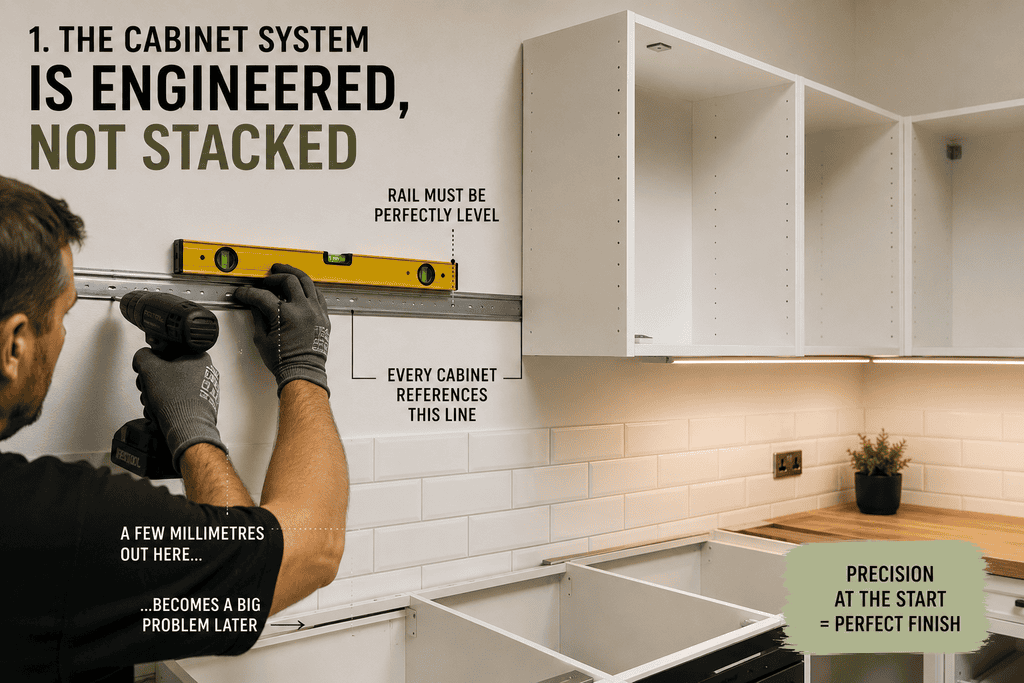
A handyman used to general carpentry will often treat this like any other cabinet job — measure, drill, fix — without appreciating that IKEA’s own tolerances leave almost no room to correct mistakes afterwards. Specialist installers who fit these kitchens regularly know the sequence has to be right from the very first unit.
2. Sequencing the cabinets is its own skill
There’s a specific order for assembling and hanging METOD base and wall units, and skipping ahead — starting with the units you fancy rather than the ones the system needs first — tends to create knock-on problems further along the run.

Corner units, appliance housings and end panels all have to slot into a sequence that accounts for wall irregularities, pipework and where services need to run. Fitters who install IKEA kitchens week in, week out build this sequencing into muscle memory. Someone doing it for the first time is essentially learning on your kitchen, and the mistakes tend to surface only once the doors go on and nothing quite lines up.
3. Tolerance management decides how the finished kitchen looks
This is the detail that separates a kitchen that looks fitted from one that looks like a stack of flat-pack boxes. Careless tolerance management is the main reason doors end up hanging crooked and MAXIMERA drawers start binding rather than gliding smoothly. Every wall has some degree of unevenness, especially in older London properties, and a fitter has to compensate for that without it showing.

That’s judgement built on repetition, not something a written instruction manual can fully cover. It’s also the reason a kitchen assembled correctly on day one can still look wrong by day three, once the doors and drawer fronts go on and every small inconsistency becomes visible.
4. Appliances need more than a plug socket
Integrating an oven, hob, extractor and dishwasher into IKEA cabinetry involves more than finding somewhere to plug them in. Housings need to be sized and reinforced correctly, ventilation has to be routed properly for extractors, and gas or electrical connections need to meet current regulations.

A qualified IKEA installation service will typically bring Part P registered electricians and proper plumbing know-how to this stage as standard, rather than treating it as an afterthought once the cabinets are up. Skipping this step, or handing it to someone without the right certification, is one of the more common — and more expensive — mistakes to correct later.
5. Plumbing and electrics aren’t a bolt-on extra
Sink and tap installation, waste connections, isolation valves, OMLOPP and UTRUSTA lighting circuits — these all need to be planned in alongside the cabinet run, not squeezed in once the units are already fixed. A general handyman will often need to bring in separate trades for this, which adds coordination, cost and time to a project that was meant to be straightforward.

Kitchen specialists who handle plumbing and electrics as part of the same job avoid the back-and-forth of scheduling multiple people around each other’s availability.
6. Snagging is where a good kitchen becomes a great one
The difference between a kitchen that’s “basically done” and one that’s genuinely finished usually comes down to the last few hours: door alignment, drawer adjustment, plinth fitting, cornice work, a proper walkthrough to catch anything that’s not quite right.

It’s easy to skip this stage when a kitchen already looks broadly complete, but it’s exactly the stage most likely to be rushed or missed altogether by someone unfamiliar with the system. A specialist fitter treats snagging as a defined final step rather than an optional extra, which is usually the difference homeowners notice most once they start actually living with the kitchen.
7. Getting it right the first time is genuinely faster

A standard IKEA kitchen installation, done properly, typically takes three to five days in London homes, occasionally longer where there’s complex first-fix work involved. Getting it wrong the first time rarely saves that time — it just moves it further down the line, into snagging visits, replacement parts and rescheduled trades. Homeowners who’ve been through both routes tend to say the same thing: the flat-pack boxes were never really the hard part. It’s everything that happens between delivery and a kitchen that actually works properly, day to day, that makes the difference.
The real skill isn’t in the flat pack
None of this means IKEA kitchens are a poor choice — quite the opposite, they’re popular for good reason. It just means the installation is where the real skill sits, not the flat-pack assembly itself. Anyone weighing up who to bring in is generally better off treating it the same way they’d treat plumbing or electrics: as a job for someone who does it regularly, not whoever happens to be available that week.
Explore travel, food and wellness features at Ravish Magazine, your go-to UK lifestyle magazine.