 Skip to content


Your Home Shouldn’t Look Like Everyone Else’s: The Return of Personal Interiors
There was a time when you could scroll through ten beautiful homes and struggle to work out where one ended and the next began.
White walls. Pale oak. A tasteful amount of beige. Black hardware. Perhaps a sliding barn door and a vase of carefully arranged eucalyptus for good measure.
Modern farmhouse interiors undoubtedly gave us some lovely things. They made rooms feel lighter, introduced natural materials and persuaded plenty of us that rustic didn’t have to mean twee. But somewhere along the way, a style designed to feel warm and characterful became extraordinarily easy to replicate.
And that’s the problem.
The most interesting interiors are increasingly moving in the opposite direction. Rather than trying to recreate a recognisable aesthetic, we’re becoming more interested in homes that appear to have evolved over time.
Vintage furniture beside something decidedly contemporary. Colours chosen because the owner loves them rather than because they’re trending. Art with a story. Objects brought home from travels. Slightly odd inherited pieces that shouldn’t necessarily work but somehow do.
In other words, personality is coming back into our homes.
We’re Tired of Homes That Look Like Show Homes

Pinterest and Instagram have given us unprecedented access to interior inspiration, but they’ve also made it remarkably easy for particular looks to spread.
One beautiful kitchen inspires another. That inspires another. Before long, the same lights, chairs, paint colours and decorative accessories seem to be everywhere.
There’s nothing wrong with taking inspiration from somebody else’s home. Most of us do.
But a room becomes much more interesting when you can’t immediately identify the trend it was designed around.
Instead of asking, “How do I get the modern farmhouse look?”, a better question might be:
“What do I actually want my home to feel like?”
Warm? Dramatic? Elegant? Playful? Calm? Slightly eccentric?
Starting there creates a very different interior.
1. Grandmillennial Style Is Bringing the Pretty Stuff Back
Minimalists, avert your eyes.

Grandmillennial interiors embrace many of the things we spent years removing from our homes: pattern, decorative detail, antiques, florals, china, pleated lampshades and furniture that quite clearly wasn’t delivered in a flat-pack box last Tuesday.
The trick is that this isn’t about recreating your grandmother’s sitting room exactly as it was in 1987.
Traditional elements are mixed with contemporary ones.
An antique chest might sit beneath modern artwork. A floral armchair can work alongside a clean-lined sofa. Vintage china can be displayed in a kitchen with thoroughly modern appliances.
It’s the contrast that stops the look becoming a period piece.
And unlike buying an entire matching furniture collection, it allows a room to develop gradually as you find things you genuinely like.
2. Moody Colours Are Making Rooms Feel Interesting Again
After years of white, greige and barely-there neutrals, darker interiors feel almost rebellious.
Deep olive. Aubergine. Burgundy. Chocolate brown. Navy. Charcoal. Inky blue.
These shades don’t necessarily make a room feel gloomy. Used well, they can make it feel cocooning and surprisingly luxurious.
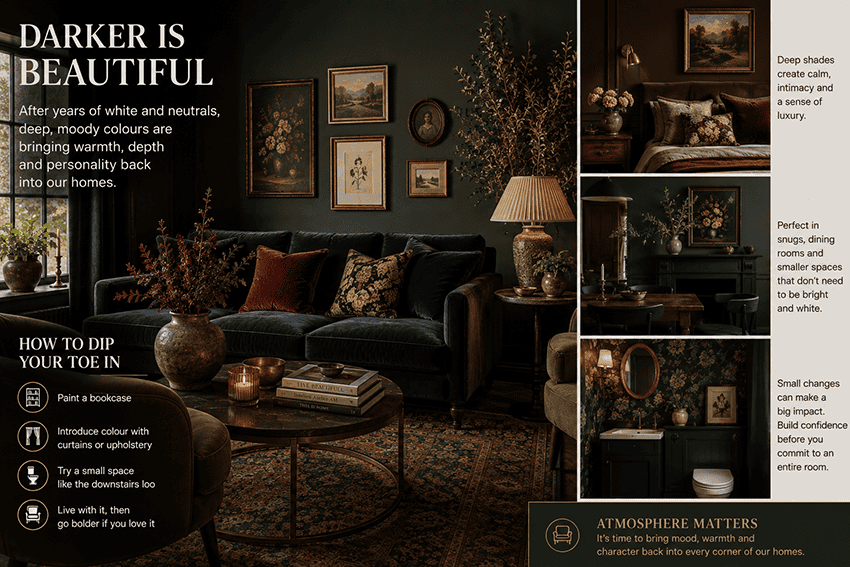
Bedrooms, dining rooms, snugs and smaller sitting rooms are particularly good places to experiment because they don’t necessarily need to feel enormous and brilliantly bright.
And if painting an entire room dark green feels terrifying, start smaller.
Paint a bookcase. Try the downstairs loo. Introduce a deeper colour through curtains or upholstery. Live with it for a while before committing to four walls and the ceiling.
The important thing is that we’re finally allowing rooms to have atmosphere again.
3. Quiet Luxury Is Replacing Disposable Décor
Quiet luxury has been discussed endlessly in fashion, but its most useful principles translate beautifully into interiors.
Forget displaying wealth. The idea is to choose fewer things that look and feel good enough to keep.
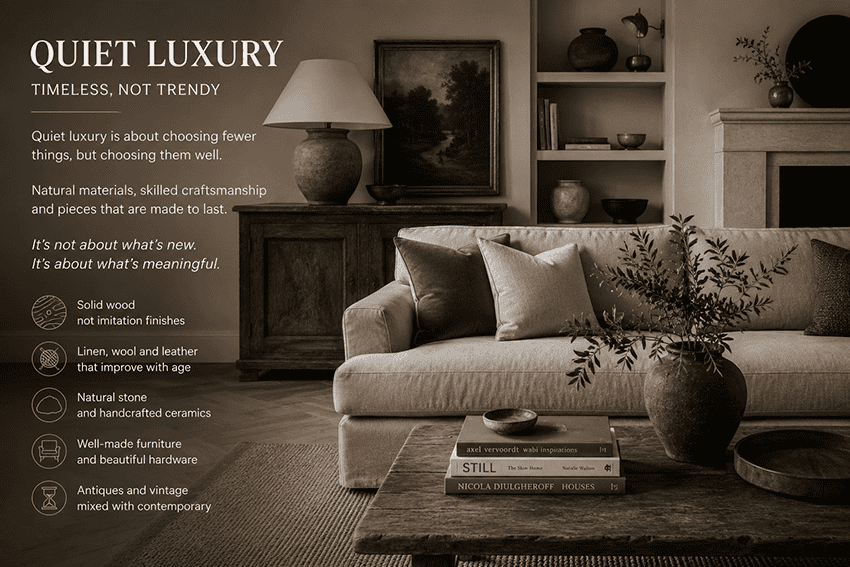
Solid wood rather than imitation finishes. Linen, wool and leather that improve with age. Natural stone. Properly made furniture. Beautiful hardware. Handmade ceramics.
A quiet-luxury room doesn’t necessarily look expensive because everything in it is new. Quite the opposite.
It can contain antiques, vintage furniture and second-hand finds alongside contemporary pieces.
What makes it successful is the emphasis on material, craftsmanship and longevity rather than novelty.
4. Vintage Is Becoming the Antidote to the Identikit Home
One of the easiest ways to prevent your home looking like everybody else’s is to buy something everybody else simply can’t buy.
That’s where vintage comes in.
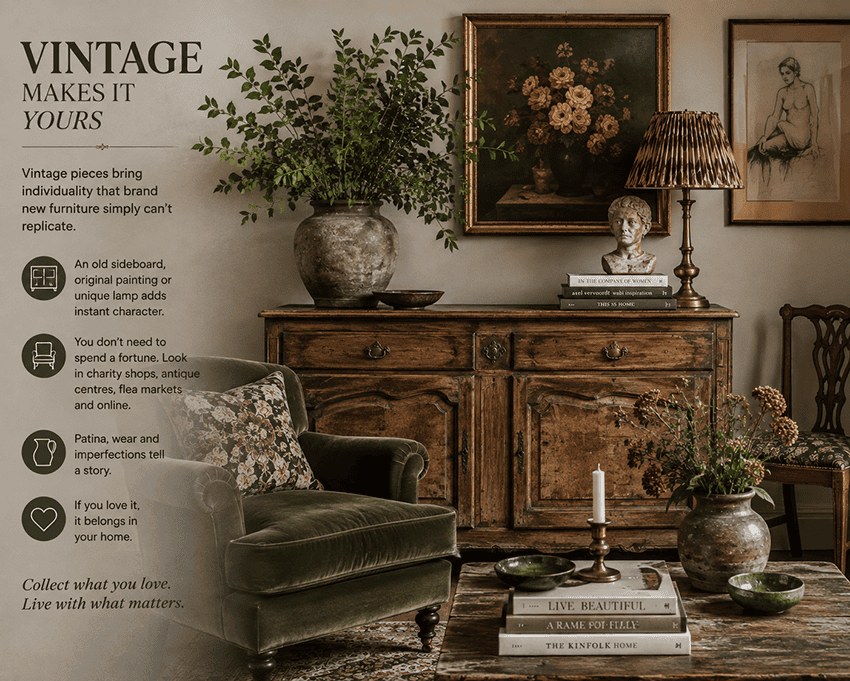
An old sideboard, original painting, unusual lamp or beautifully battered table instantly introduces individuality because it hasn’t been selected from the same current collection as thousands of identical pieces.
It doesn’t have to be valuable, either.
Charity shops, antique centres, reclamation yards, flea markets and online marketplaces can turn up pieces with considerably more character than their price tags suggest.
And don’t worry about identifying the precise “style” of everything.
If you love it, that’s usually a better starting point.
5. Collected Interiors Are Replacing Perfectly Coordinated Ones
Perhaps the biggest shift isn’t towards one particular decorating trend at all.
It’s towards mixing them.
A compelling home might contain an inherited Georgian table, a 1970s lamp, a contemporary sofa, striped cushions, modern art and a ridiculous ceramic leopard picked up on holiday.
On paper, none of it matches.
In the room, it tells you something about the person who lives there.

That’s the difference between a decorated interior and a collected one.
The latter doesn’t need to be finished.
In fact, it probably shouldn’t be.
Homes naturally become more interesting when they’re allowed to change with the people occupying them.
How to Make Your Home Feel Less Generic
You don’t need to rip out your kitchen because somebody on the internet has announced that its cabinet colour is over.
Nor should you throw away perfectly good furniture simply because it belongs to a trend that’s beginning to fade.
Instead, break up the formula.
If everything in the room was bought at the same time, introduce something older.
If everything is neutral, add one colour you genuinely love.
Swap generic wall décor for photographs, original art, prints or objects that mean something to you.
Layer a vintage rug over timber flooring.
Replace faux-distressed furniture with the real thing when it eventually needs replacing.
Change mass-produced accessories gradually rather than buying another coordinated collection.
And perhaps most importantly, stop trying to finish your house.
The Best Rooms Take Time
There’s a reason genuinely beautiful old houses often feel so effortless.
Nobody designed the entire thing in one weekend.
Furniture arrived at different times. Pictures accumulated. Books multiplied. Objects were inherited. Things travelled from one room to another. Something unexpectedly perfect was found in an antiques shop and squeezed into the car.
Those layers are incredibly difficult to manufacture instantly.
It’s also why chasing interior trends can become exhausting. As soon as you’ve successfully recreated one look, somebody announces that it’s over and presents another collection of things you’re apparently supposed to buy.
A more individual approach gives you permission to opt out.
So, Is Modern Farmhouse Really Over?
Not necessarily – and if you genuinely love it, declaring it unfashionable shouldn’t make the slightest difference to your home.
The elements that made modern farmhouse appealing in the first place aren’t suddenly unattractive. Natural wood, comfortable furniture, practical kitchens and relaxed rooms aren’t going anywhere.
What’s beginning to feel tired is the formula.
A home doesn’t need barn doors, black taps, white walls and rustic signs to feel welcoming. Nor does embracing colour, antiques or pattern mean subscribing wholesale to another trend.
Take the parts you like. Ignore the rest.
Because perhaps the most interesting interiors movement isn’t grandmillennial, quiet luxury or moody colour at all.
It’s the gradual return of the idea that your home should look like you live there.
And preferably not like everyone else does.
Original story concept and expert commentary supplied by SmartMove.us.
Explore travel, food and wellness features at Ravish Magazine, your go-to UK lifestyle magazine.