 Skip to content


10 Easy Decluttering Tips for a Calmer, More Organised Home
A cluttered home can creep up on you. A few things left on the kitchen worktop become a permanent pile, the wardrobe gets harder to close and suddenly there is an entire cupboard you would rather not open.
The good news is that decluttering your home doesn’t have to mean emptying every drawer onto the floor and sacrificing an entire weekend to sorting it all out.
Some of the best decluttering tips are surprisingly simple. The key is to tackle your belongings in a way that prevents the job from becoming overwhelming — and to introduce a few habits that stop clutter gradually building up again.
Whether you want to clear an overflowing wardrobe, reclaim your kitchen cupboards or simply make your home feel a little more organised, these ten practical decluttering methods are a good place to start.
1. Start With the Area That Annoys You Most
Forget trying to declutter the entire house at once. Start with the space that regularly frustrates you.
It might be the kitchen worktop where everything gets dumped, the chair permanently covered in clothes or the hallway cupboard that has become impossible to navigate.
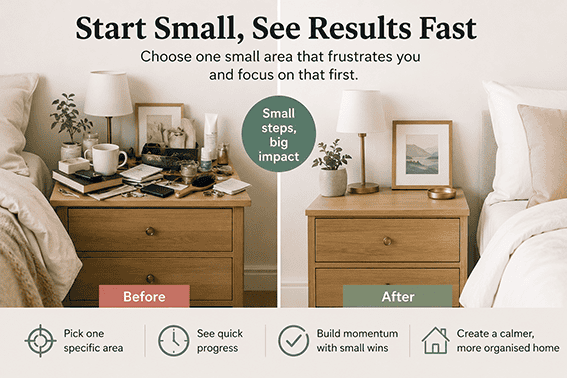
Concentrating on one defined area gives you a visible result relatively quickly. That little win can make it much easier to move on to the next job.
Make the target specific. Rather than deciding to “sort the bedroom“, choose the bedside tables, one chest of drawers or the top shelf of the wardrobe.
Small areas get finished. Entire rooms have a habit of becoming half-completed projects.
2. Use the 1-3-5 Decluttering Method
If you have a larger area to tackle, the 1-3-5 method can make it considerably more manageable.
Choose:
- 1 large task
- 3 medium tasks
- 5 small tasks
For example, your large task might be to declutter your wardrobe.
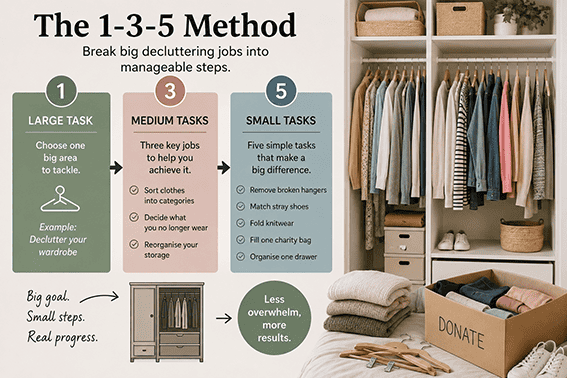
The three medium jobs could be sorting your clothes into categories, deciding what you no longer wear and reorganising your available storage.
Your five small jobs could then include removing broken hangers, matching stray shoes, folding knitwear, filling one charity bag and organising a single drawer.
Instead of facing one enormous job, you now have a series of clearly defined tasks that you can work through one by one.
3. Try the 12-12-12 Challenge When You Don’t Know Where to Begin
When clutter is everywhere, deciding where to start can sometimes be the hardest part.
The 12-12-12 decluttering method gives you a simple target. Find:
- 12 things to throw away or recycle
- 12 things to donate or sell
- 12 things to put back where they belong
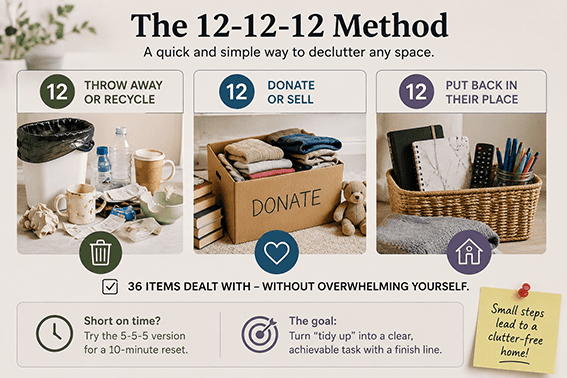
That’s 36 items dealt with without having to reorganise an entire room.
You don’t have to follow the numbers rigidly, either. A smaller 5-5-5 version works perfectly well when you only have ten minutes.
The point is to replace the vague instruction to “tidy up” with a measurable task that has an obvious finishing point.
4. Create a Home for the Things You Actually Use
Decluttering isn’t only about owning fewer things. Sometimes the problem is that useful belongings simply don’t have a logical place to live.
Look at the objects that repeatedly end up lying around your home.
Keys accumulating on the kitchen worktop may need a bowl or hook near the door. Shoes scattered through the hallway may need a basket or rack. Post piling up on a table may need a dedicated tray.
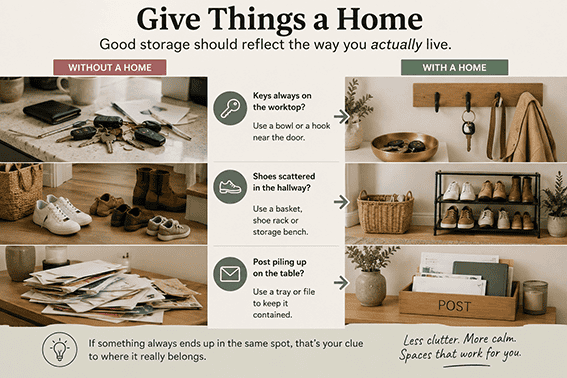
Good storage should reflect the way you actually live rather than the way you think an organised home ought to work.
If an item continually ends up in the same inconvenient place, consider whether that’s telling you where its proper home should be.
5. Turn Your Clothes Hangers Backwards
This is one of the easiest ways to discover which clothes you genuinely wear.
Turn all the hangers in your wardrobe so that they face the opposite direction. Whenever you wear something, return it with the hanger facing normally.
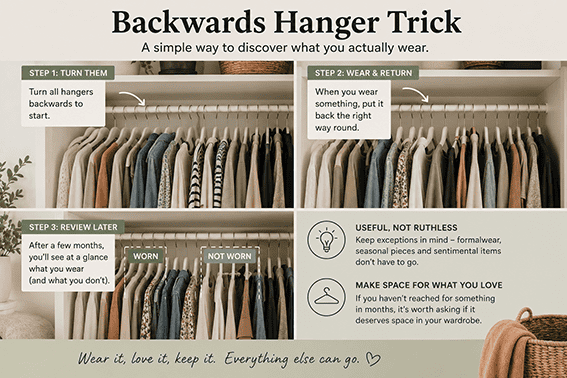
After several months, you’ll have a surprisingly clear picture of which clothes are being worn and which have remained untouched.
That doesn’t mean everything on a backwards hanger automatically has to go. Formalwear, seasonal clothes and sentimental pieces are obvious exceptions.
But if you discover ten tops you haven’t reached for once, it’s worth asking whether they deserve valuable wardrobe space.
6. Use a ‘Maybe Box’ for Things You Can’t Decide On
One of the biggest decluttering stumbling blocks is the item you don’t particularly want but can’t quite bring yourself to get rid of.
Instead of spending ages debating it, create a maybe box.
Put uncertain items inside, close the box and store it somewhere out of sight. Set yourself a reminder to revisit it in a month or two.
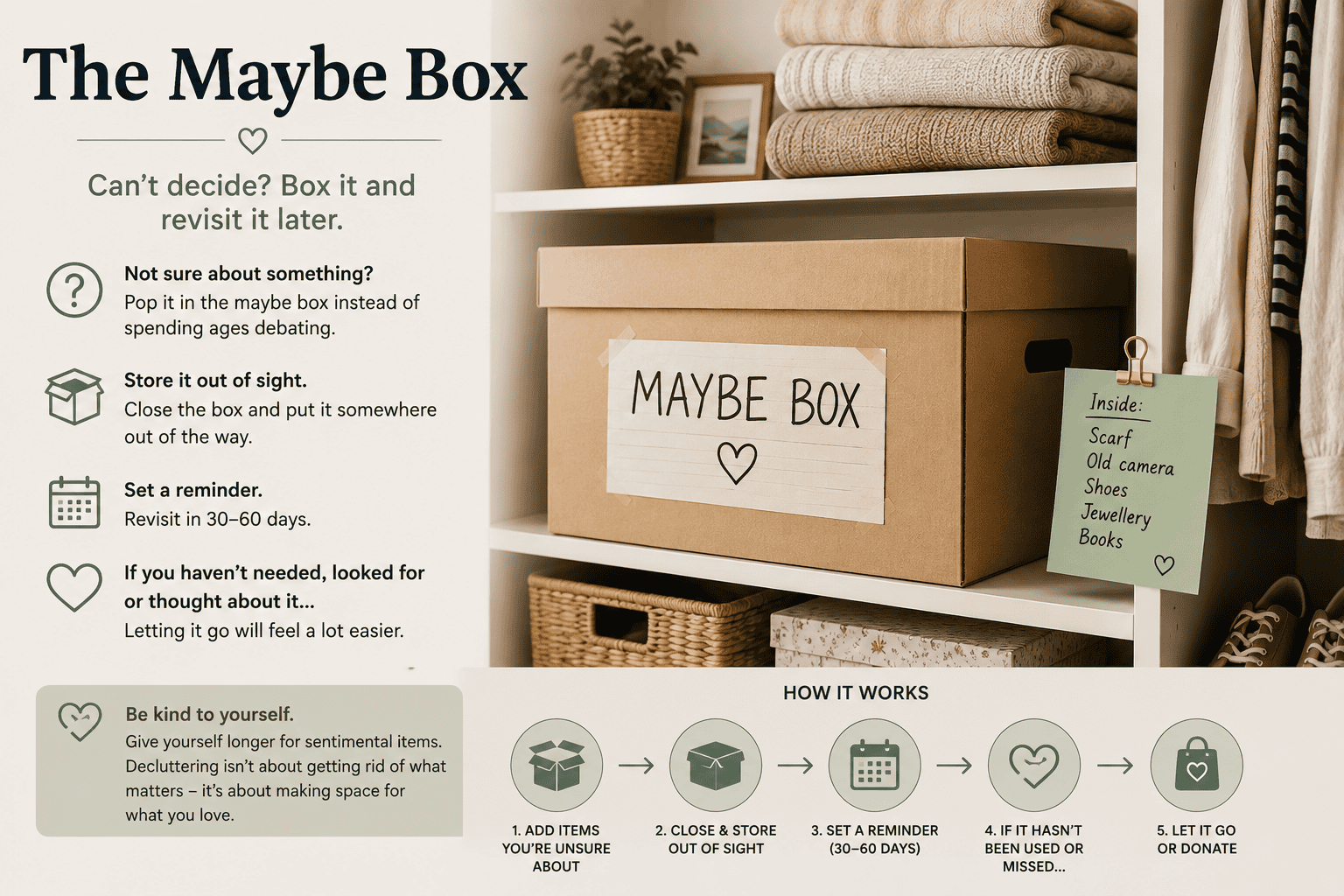
If you haven’t needed, looked for or even thought about something during that period, letting it go may suddenly feel much easier.
For sentimental possessions, give yourself longer. Decluttering shouldn’t mean throwing away things that genuinely matter to you simply to achieve a tidier cupboard.
7. Follow a One-In, One-Out Rule
Getting rid of clutter is only half the battle. Preventing it from returning is what keeps a home organised.
A simple one-in, one-out rule can help.
Buy a new coat? Consider whether an old one can be donated. Add another book to an already packed shelf? Choose one you’ve finished with. Replace a kitchen gadget? Remove the old version rather than pushing it further into the cupboard.

This works particularly well for categories that tend to multiply unnoticed, including clothes, shoes, children’s toys, mugs, toiletries and kitchen equipment.
For areas where you already own far too much, you could temporarily make it one in, two out until things become more manageable.
8. Declutter by Category, Not Just by Room
Sometimes clutter becomes difficult to spot because similar items are spread around the house.
Try gathering one category together before deciding what to keep.
You might collect every candle, reusable shopping bag, cleaning product, notebook or spare toiletry you own and put them in one place.

Seeing the total quantity can be revealing. Four half-used bottles of the same cleaning product suddenly look very different when they’re sitting together rather than hidden beneath four different sinks.
Keep the best or most useful items, use up duplicates where appropriate and give the remaining collection one dedicated storage area.
It also makes future shopping easier because you’ll know what you already have.
9. Be Realistic About Your ‘Just in Case’ Items
Most homes contain things being kept for a hypothetical future.
A cable for a device you no longer own. Clothes that haven’t fitted for years. Empty boxes that might one day be useful. A kitchen appliance bought for a recipe you made once.
Before keeping something “just in case”, ask yourself three questions:
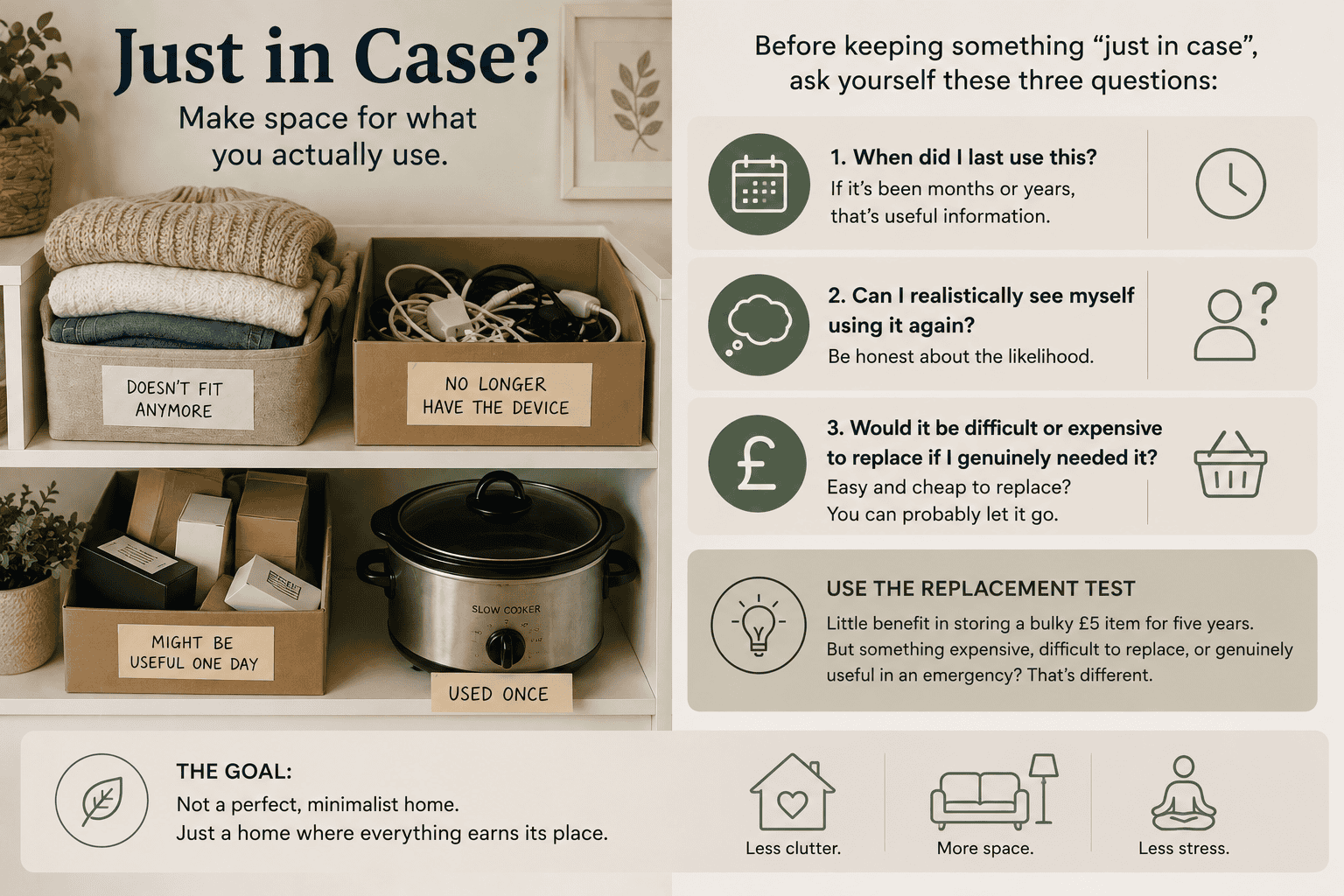
When did I last use this?
Can I realistically see myself using it again?
Would it be difficult or expensive to replace if I genuinely needed it?
That final question is particularly useful.
There is little benefit in storing a bulky £5 item for five years because you might theoretically need it one day. Something expensive, difficult to replace or genuinely useful in an emergency is a different matter.
The aim isn’t ruthless minimalism. It’s making sensible decisions about what deserves space in your home.
10. Finish Every Decluttering Session by Removing the Clutter
This is the step people often forget.
You’ve spent two hours decluttering and now have three bags for charity, a pile for recycling and several things you intend to sell.
Don’t allow those piles to become the home’s newest form of clutter.
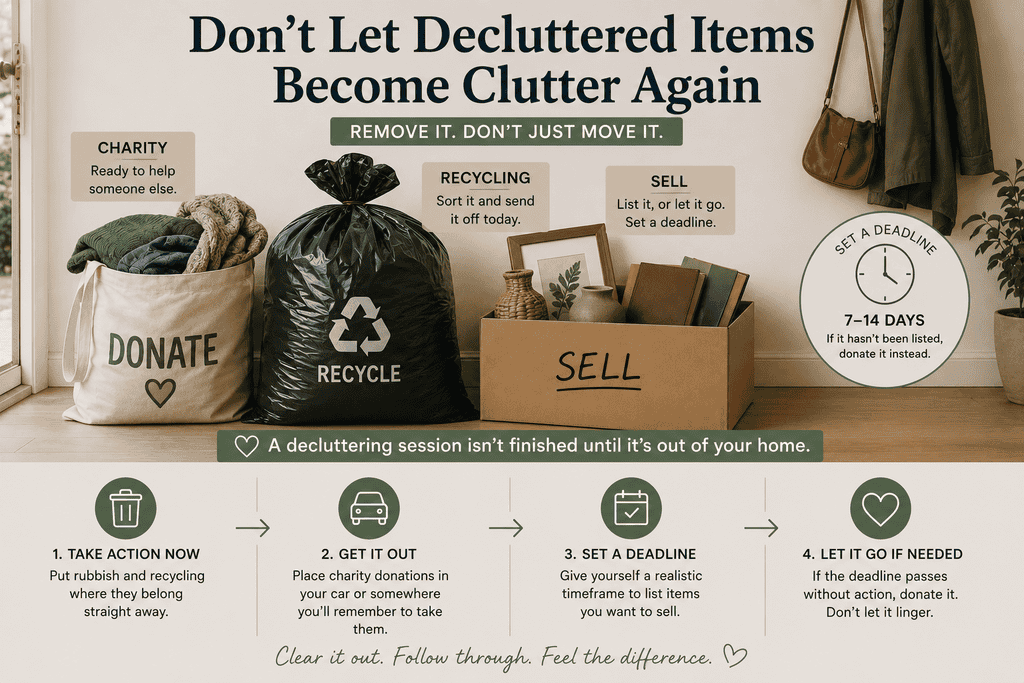
Put rubbish and recycling where it needs to go straight away. Place charity donations in the car or somewhere you’ll remember to take them. Give items you’re planning to sell a deadline.
If they haven’t been listed within that time, consider donating them instead.
A decluttering session isn’t really finished until the things you’ve decided to remove are actually on their way out of your home.
Where Should You Start When Decluttering Your Home?
If your whole house feels cluttered, don’t begin with the most difficult room.
Choose one small, visible area you can realistically complete in 15–30 minutes. A kitchen worktop, bedside drawer, bathroom cabinet or one wardrobe rail is ideal.
Sort everything into four simple groups:
Keep: things you use, need or genuinely value.
Donate or sell: useful items you no longer want.
Recycle or dispose: damaged, expired or unusable items.
Relocate: things you’re keeping that belong somewhere else.
Finish that one area before starting another.
The difference between successful decluttering and simply moving clutter around is making a decision about each item and following through on it.
How to Keep Your Home Clutter-Free
The easiest home to declutter is the one that doesn’t require another enormous clear-out six months later.
Once you’ve created some breathing space, introduce small habits that help maintain it. Return things to their proper place when you’ve finished with them, deal with post rather than creating a paper pile and think about what will leave your home before bringing unnecessary new purchases into it.
A quick ten-minute reset at the end of the day can often prevent small amounts of mess becoming much bigger jobs.
Most importantly, don’t aim for a home with nothing in it.
A comfortable home will contain books, clothes, photographs, kitchen equipment and all the other belongings that come with actually living in it. Decluttering is simply about removing the things that no longer serve you so that the things you use and enjoy are easier to find.
And that’s considerably more achievable than trying to become a minimalist overnight.
This article incorporates established decluttering approaches, including the 1-3-5, 12-12-12, backwards-hanger and maybe-box methods previously supplied to Ravish Magazine by Online Bedrooms.